
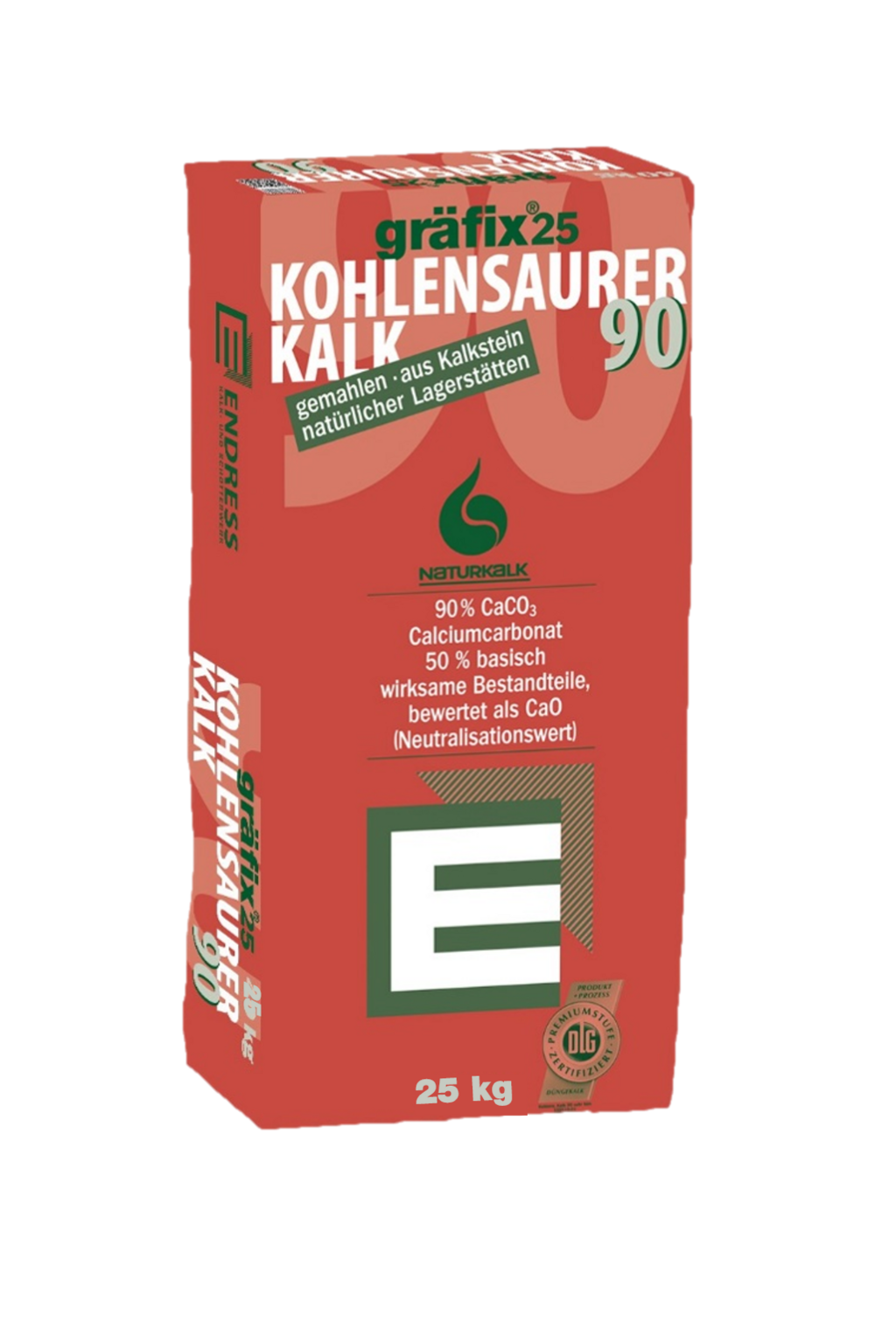
gräfix 25 Carbonated Fertilising Lime 90
Carbonated fertiliser lime 90
Finely ground, carbonated lime improves soil quality in agriculture, orchards, vegetable gardens, on green spaces and in flower beds, and helps to preserve and restore our forests, amongst many other benefits.
In the long term, lime significantly improves the condition and fertility of soils; as a result, not only is higher-quality food produced, but lime also ensures higher yields and greater economic efficiency.
Carbonated fertilising lime 90 · moist
Delivery: 25-kg bag or in bulk
Sales information via Düka, Neutraubling
www.dueka.de

- Unslaked lime
- ground
- fine
- Supplied in 40-kg paper sacks or in bulk
- 30 sacks per pallet/1.2 tonnes
Sales information from Düka, Neutraubling
www.dueka.de
Lime in forestry, pond management and agriculture
Spreading lime fertiliser on agricultural land counteracts acidification and has a positive effect on soil nutrient levels. Different particle sizes are recommended depending on soil conditions. Human and animal organisms require the element calcium as an essential component of, for example, the skeletal structure. A diet that is deficient in calcium can lead to bone softening and fragility. In agriculture, ground, carbonated (i.e. unburned) lime is used as feed lime. As with fertilising lime, the law imposes specific quality requirements on its composition. The lime wash commonly applied in farm buildings protects against disease, as lime disinfects and sanitises.
Viruses, salmonella and E. coli bacteria in slurry are also destroyed by the addition of lime. This means that slurry can be applied to fields safely. Lime is also used in fish farming for a wide range of sanitisation measures. Its most important role, apart from neutralising the water, is to destroy parasites harmful to fish stocks, thereby improving the fish’s health. The Endress Gräfenberg quarry was formed during the Mesozoic Era, in the Jurassic period, between 130 and 190 million years ago.